 AI Boost X
The harness is the team: one day at Google Cloud's Agents for Impact Hackathon
Everyone at the table had AI agents running. Mine came with a team.
At the one-day hackathon, I built 80% of the deliverables for the team of 6. How come? Because the agent harness was already running on my computer. I launched one new session for Google Cloud's Agents for Impact Hackathon in Toronto, and it started working right away with a team that was already set up, each agent in its own role. The harness and the hierarchy come with every session I launch. Plug and play, and portable.
The team was already there
| Role | What it did on the day |
|---|---|
| Conductor | Split the work, gated the cloud calls and relayed my decisions |
| Builder, the new session | Wrote the agent, deployed it, captured the evidence and ran the tests |
| Designer | The deck, the logo, the diagrams and the video |
| Red team | Wrote its checks before the work existed, then reviewed against them |
| Cold reader | Read our deck the way a judge would, with nothing but the brief and the evidence |
| Workers | Benchmarks, a validation rerun, icons and timing runs |
I made the calls: the merges for my part, the model, the design direction and the submission. My teammates built the coordinator console and the pitch.
That team was set up long before today.
What we built: RescueBroker
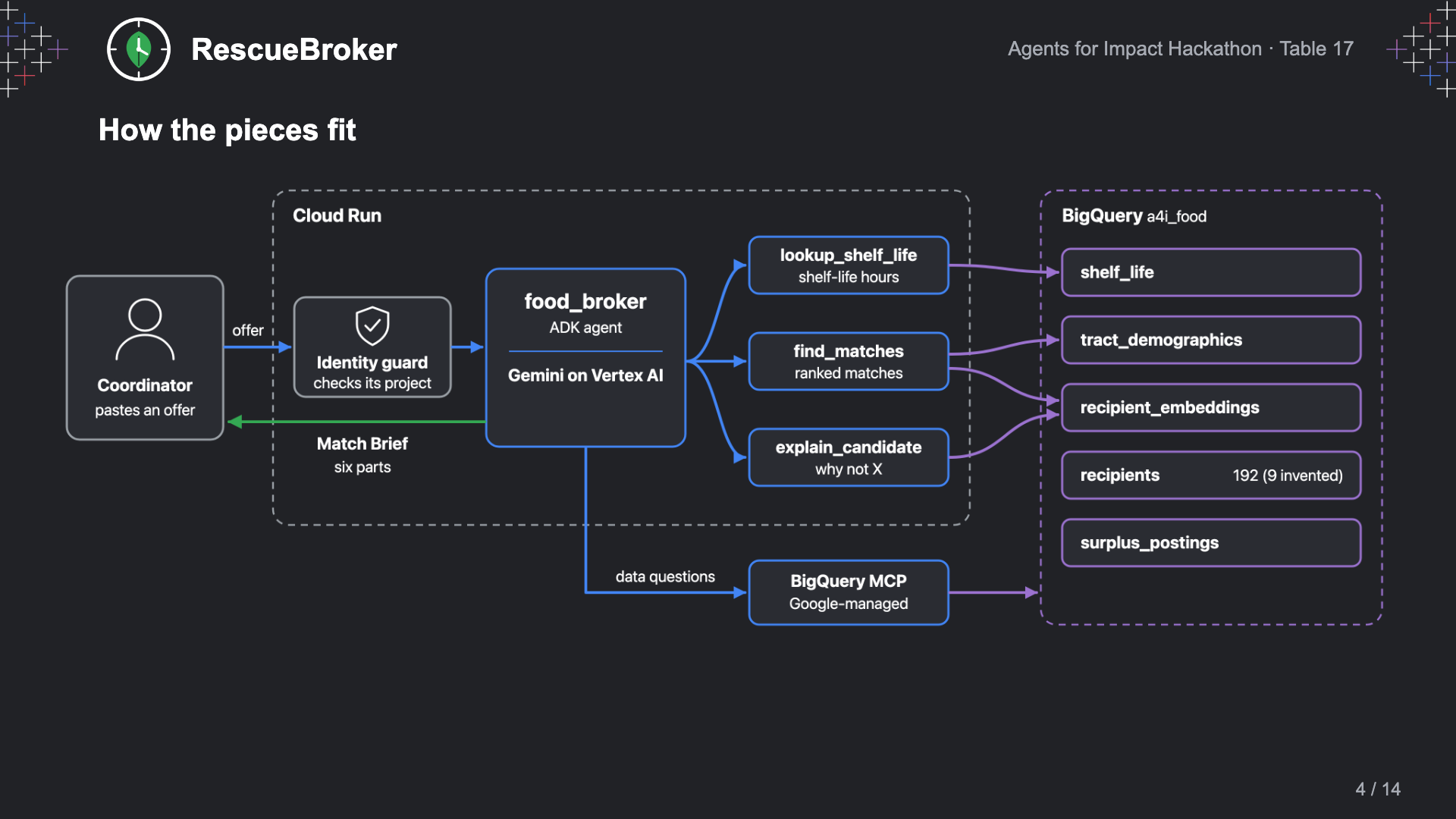
Our challenge was Track 1, Challenge 2: a food-rescue broker for Chicago. A coordinator types an offer such as "10 crates of spinach, harvested yesterday, needs cold storage". The agent finds who can store it, take it and collect it in time, ranks them, and writes a six-part match brief with a message ready to send. The search has to go wide: the 15 closest matches gave 1 option, and 80 gave 12.
What the hierarchy caught before we submitted
- 9 invented organizations planted in the challenge data, kept out of the audit and labelled in our answers
- a number that counted the wrong group, and one of our own counts that was off by one
- a security gap in a data tool, fixed and proven before submission
23 of the organizers' 25 validation checks pass, and we know why the other 2 don't.
When models change, the harness is the product
At a hackathon, the harness is the team.
When you start a new project, do your agents start from zero, or join a team?
How the agents built the slides and the video
The pitch deck came from the same team, in one afternoon:
- The designer proposed three logo concepts and a title page with the event banner. I picked the logo and the title page, then asked for fewer words and more flow charts.
- A worker under the builder drew the architecture diagram and the icons as SVG.
- One slide spec builds the PowerPoint, the PDF and the images, and a fit check makes sure no text spills out of its box.
- Every number on a slide comes straight from the repo when the deck builds.
- The red team and a cold reader reviewed the deck. Each fix went into a new version, and the old ones are kept.
Then the designer turned the same slides into a narrated cut, as a fallback in case our own recording wasn't ready. Each slide builds in on cue, and the diagrams light up as the voices reach them. Both voices are AI voices from Gemini 3.8 Live, a host and a guide, and the title slide says so.
Built with
- Event: Agents for Impact Hackathon, Google Cloud, Toronto, 20 October 2026. Track 1, Challenge 2: Resilient Food Equity & Surplus Broker.
- The product: ADK, Gemini 3.8 Flash on Vertex AI, BigQuery vector search, Google's managed BigQuery MCP server and Cloud Run, at about 20 seconds per answer.
- The agent team: Claude Code sessions.
- Code: github.com/jimmycgz/challenge2-117
- Slides and video: from our pitch deck. The numbers come from the repo's evidence and equity audit. Recipient names are real, from IRS records, except nine invented test cases in the challenge data. Storage, capacity and pickup times are generated for this prototype.