 AI Boost X
I built an Agent Framework Titan-Kronos: Implemented in Production at scale
The Problem to Be Resolved:
A firefighting campaign following the Glasswing initiatives: hundreds of pipelines need a hotfix across 500 code repositories, which is impossible for the already overloaded human engineers to fulfill.
What Happened:
I built the agentic workflow that made all the code changes. The whole implementation is assembled into one simple slash command on Claude Code, which fans out hundreds of subagents for code refactoring and gate reviews, and yields near-perfect accuracy in code changes. A human reviews the result.
This blog tells the true story from production implementations and explains how the agentic framework conducts the work:
one agent fixes each repo, and a separate gatekeeper with fresh context reviews every change before another agent opens a draft pull request, with very limited human in the loop, while keeping a high quality bar.
Raised the bar on the first day of Fable 5 release:
I didn't give it new work. I pointed it at the agent skill Opus 4.8 had just built and had it review that skill adversarially. It found 12 real bugs the older model had missed, and fixed them. Two days later, the skill went from "almost done" to production-ready.
When models change, the harness is the product.
Who does what
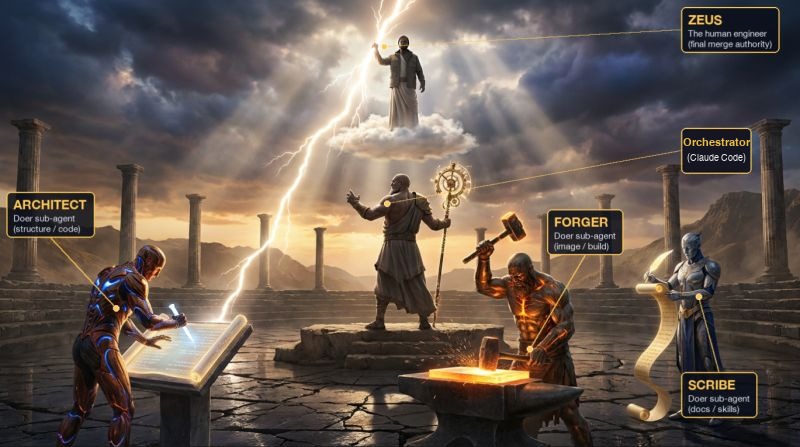
I drew the setup as a pantheon. I'm Zeus: the human engineer, with final merge authority. An orchestrator runs in Claude Code. Three doer sub-agents do the work: an architect for structure and code, a forger for images and builds, and a scribe for docs and skills.
How fleet campaigns run in production
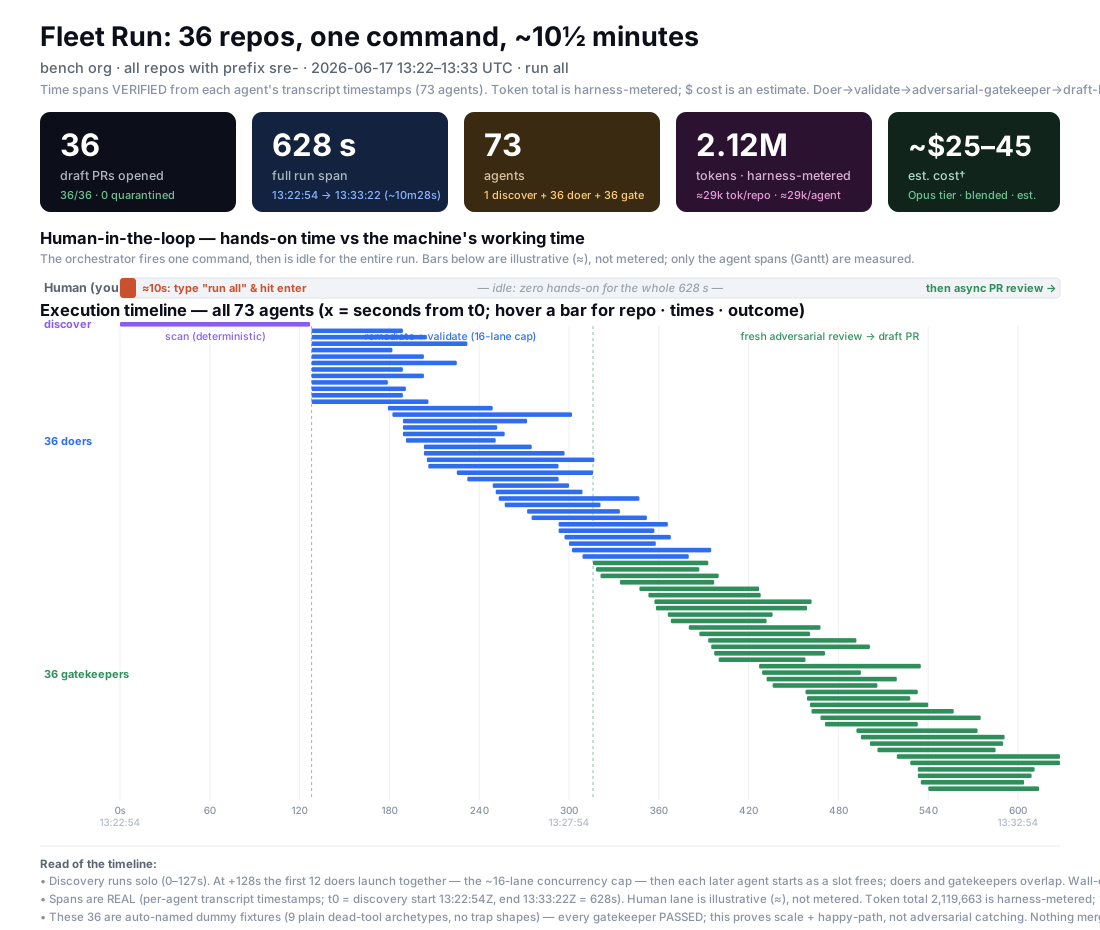
Six days later, a test fleet ran the same shape, where every piece of work gets its own adversarial reviewer: one command, 36 repos, about 10½ minutes. One agent discovered the repos. Then 36 doers each fixed a repo, and 36 fresh gatekeepers each reviewed a doer's work adversarially before a draft pull request opened. It opened 36 draft pull requests and quarantined none. The harness metered 2.12M tokens.
The limit, stated plainly: the 36 repos were auto-named test fixtures with no traps in them, so every gatekeeper passed. The run proves scale and the happy path, not that the gatekeepers catch problems. Nothing was merged. All 36 pull requests waited for review, and a second run opened no duplicates.
Achievements
1. I made the discovery script in my agent workflow more than 10 times faster. Tested on 86 repositories and run on a production fleet of well over a hundred. The script runs six checks at once and merges three pull-request calls per repository into one, so six calls became four.
2. The workflow runs in production, with no wrong change found. The first campaign removed dead tooling across a production fleet of well over a hundred repositories, through pull requests merged to production.
3. A safety gate built into the harness: the reviewer agent caught the working agent before any pull request existed. The gate runs on every change. A separate gatekeeper agent, starting from a fresh context, reviews every change before a pull request is opened, and every change opens as a draft pull request that a human reviews and merges. In one repository the first agent removed a check that was still live; the gatekeeper failed it, and no pull request was opened.
4. It manages repository shapes dynamically, beyond static patterns. Fixed patterns like regular expressions break on look-alikes. The agent judges a repository by what its configuration does, not by what it is named, and a separate reviewer checks that call. The next step is to turn each new shape found in production into a new archetype.
5. It can plug into policy-as-code frameworks such as OPA. Agent actions can be allowed, denied or modified by Rego policies compiled to WebAssembly.
More Facts
Built via Claude Code Dynamic Workflow with model tiering.
| Reviewer | Fable 5, on its first day |
|---|---|
| Reviewed | an agent skill Opus 4.8 had built |
| Real bugs found and fixed | 12 |
| Time | two days, from "almost done" to production-ready |
| Bill | $690: $500 of Fable 5 and $190 of Opus 4.8, about 10M tokens |
| Next | rolling out to 150 repos, scan and remediate |
That day I asked a question I'm still asking CEOs: would you approve $500 a day for one engineer to boost their output 100x with the most powerful AI available?
The original post is on LinkedIn.