 AI Boost X
How I scale delivery with AI
AI Boost
Mindset Shift: How many x can you boost or scale with the super power of AI? How to achieve 10x 100x?
The Boost Levels
I built the AI frameworks and workflows that took my delivery from 1–3x earlier to 10–100x recently — in production, at scale, with high quality.
* If you are still struggling the single chat with any AI, think about shift to Context Engineering.
* If you never thought about 100x, read all of my stories already happened in production as scale.
Chat with one AI10–50%
Context engineering, grown from prompt engineering1–3x
Agent engineering: harness, fleet, loop10–100x
1x3x10x30x100x
How to Scale with Quality?
I build agent workflows, harnesses and skills in Claude Code daily, and I've run multiple agent-driven campaigns in production at scale on the Scan-and-Action Framework (SAAF). Everything gets reviewed before anyone else sees it.
Framework: Long-Horizon
I built a harness of my own, Long-Horizon, for agent work that runs for hours or days and survives interruption. It pairs a stateless dispatcher with a durable checklist, so the work outlives any single session.
In one proving run, it completed 32 checklist items across 21 sessions in 9 hours with zero human interventions — recovering on its own from a quota exhaustion, a two-hour operator absence, an abandoned 46 GB transfer, and two network outages.
How I run an agent team
Conductor: plans and assigns, counts the votes and never casts one · an hourly beat resumes the run after a failure
- 1Build11 designs, built and previewed locally
- 2Vote6 reviewers, 2 of them cold; each ballot a file
- 3Red team2 passes, separate from the builders
- 4Fix & re-checkby a script first shown to catch planted errors
- 5I picknothing ships before
- One conductor plans and assigns; worker sessions build; the conductor counts the votes and never casts one.
- It runs unattended overnight, with an hourly beat that picks the run back up after a failure.
- Eleven designs were built and previewed locally, then chosen by a vote of six reviewers — two of them brought in cold, with no prior context — each ballot written as a file.
- An independent red team, separate from the team that built them, argued how each design could hurt me, in two passes, before anything reached me.
- Every fix was applied and re-checked by a script that had first been shown to catch planted errors.
- Nothing ships until I pick.
Related: my LinkedIn post on Claude Code dynamic workflows with Fable 5 →
Why the harness holds quality at scale
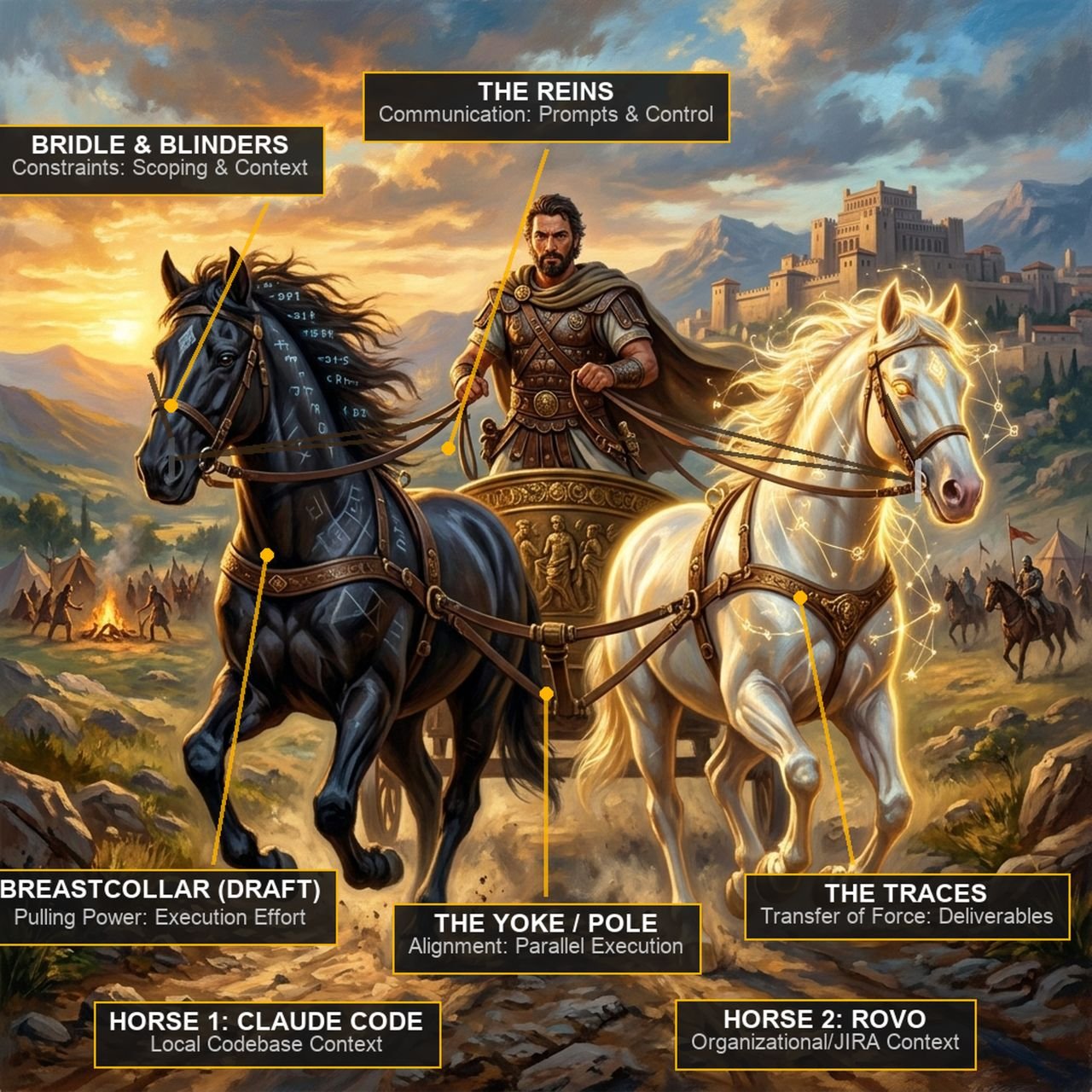
Ride one AI horse on its own and the ride can get wild. In a harness, two horses pull one load in the same direction. The reins are my prompts and control, the blinders keep each horse on its own context, and the yoke keeps them in step. Claude Code brings the codebase, Rovo brings the organization's knowledge, and in one afternoon they took a design to what I'd call near perfect: Rovo's final review found every design decision traced back to the code or the docs. Read how →
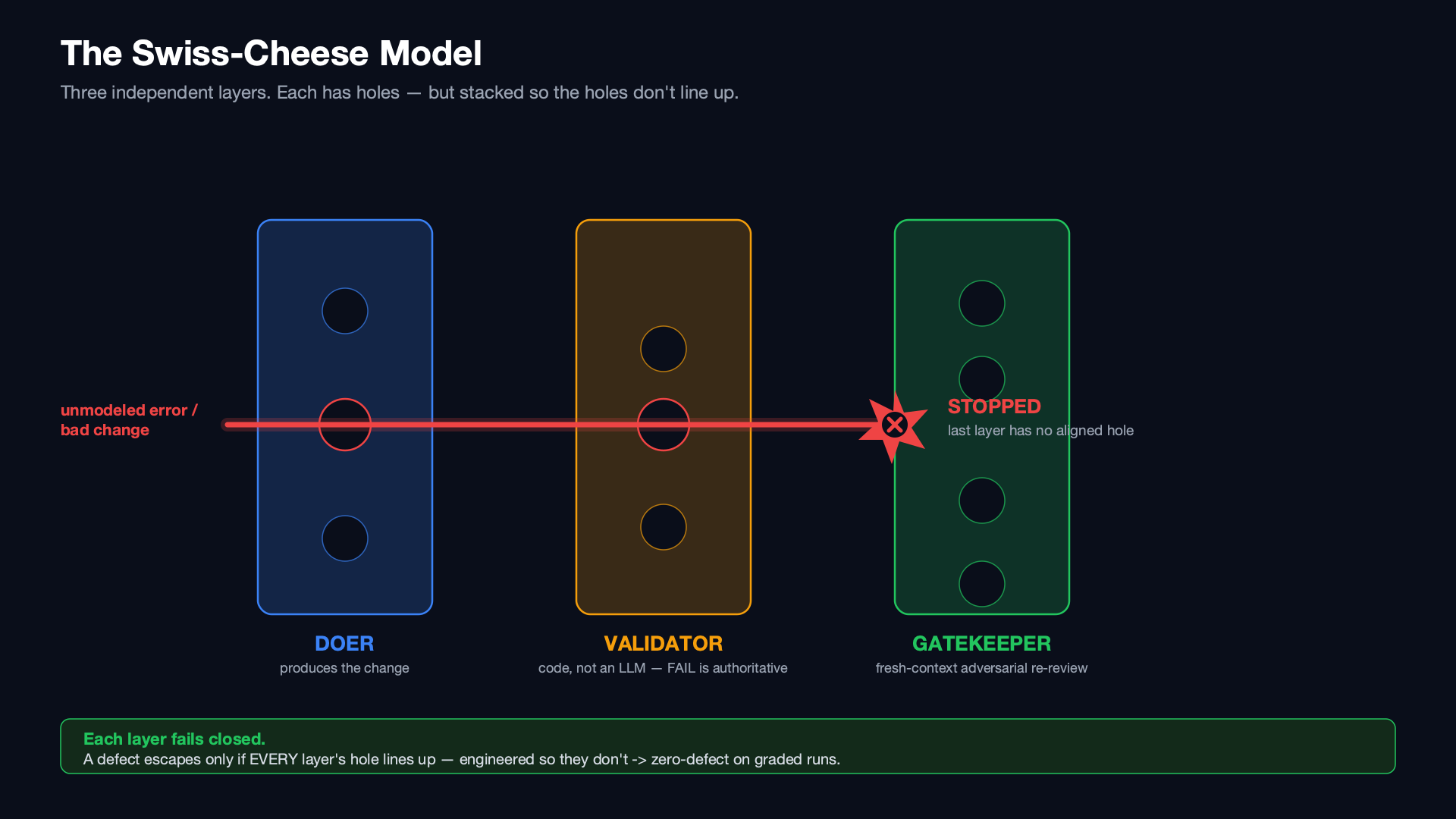
The Flawless Design Pattern: Swiss-cheese model
Every check has holes, so I stack independent ones, a doer, a validator and a gatekeeper, and a bad change has to get past all three.
- Every result is reviewed by someone other than its author before it reaches a person — a second session, or an independent reviewer with no stake in it.
- I seat an adversarial reviewer for anything that matters, whose job is to find how it fails.
- I don't trust a check until it's been shown able to fail first, on a planted fault.
- The work outlives any single session: checkpoints to git, a durable checklist, and a dispatcher that resumes after a crash, a quota limit, or an outage.
- Claims get pulled from the source, not from memory, in the same turn they're made — a relayed fact stays marked as relayed until it's confirmed.
- Anything that touches a live system runs with a second session watching each change, with a rollback written first.
As an AI coach, I advocate an AI mindset shift and share how to boost 100x
I lead the BrainTrust knowledge-sharing series — about six years now, from around 2020. It's run to 150+ sessions, 61 of which I've delivered personally, 40+ hours in all. I'm Principal of API University, with more than 30 internal learners, and I'm ramping a 15-person team now.
vibe-coding-tools
My public agent skills, including VibeDeck and image processing.
LinkedIn posts, on the blog
Notes on Claude Code, Antigravity, and agent harnesses; write-ups are coming.